Euclidean Distance Score
October 30th, 2008 | Published in Uncategorized | 1 Comment
I am currently reading Toby Segaran’s book “Programming Collective Intelligence” and one of the first topics it covers is how do you determine of similar two people are.
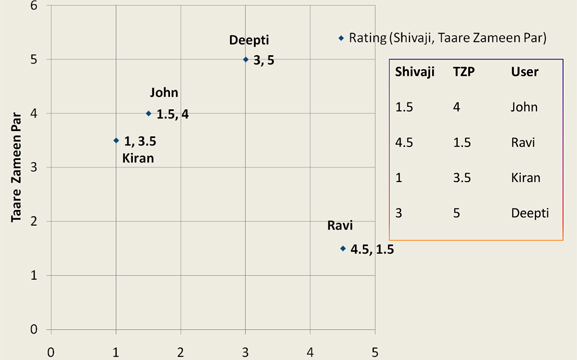
One approach is to use the Euclidean Distance Score. Arun Vijayan C has an excellent power point presentation “Finding more people like you” – on this topic:
I then wrote up some quick code in C# that uses the values in Arun’s presentation:
// Euclidean Distance Score

using System;
using System.Collections.Generic;

namespace ConsoleApplication1
{
    internal class Program
    {
        private static void Main()
        {
            // Load People and Values
            var myP = new List
                          {
                              new People("John", 1.5, 4),
                              new People("Ravi", 4.5, 1.5),
                              new People("Kiran", 1, 3.5),
                              new People("Deepti", 3, 5)
                          };

            // Print header
            Console.WriteLine("People And Scores");
            Console.WriteLine("###################");
            Console.WriteLine();

            // Loop through people and values
            foreach (People people in myP)
            {
                Console.WriteLine(people.Name + "\t" + people.xScore + "\t" + people.yScore);
            }

            // Print Distance And Value Headers
            Console.WriteLine();
            Console.WriteLine("Distance Comparison");
            Console.WriteLine("###################");
            Console.WriteLine();

            // Loop through people and scores
            int myCount = 1;
            for (int i = 0; i < myP.Count; i++)
            {
                for (int j = myCount; j < myP.Count; j++)
                {
                    // Euclidean Distance Score
                    // Sqrt( (x1-x2)^2 + (y1+y2)^2)
                    Console.WriteLine(myP[i].Name + "\t" + myP[j].Name + ":\t" +
                                      Math.Sqrt(Math.Pow(myP[i].xScore - myP[j].xScore, 2) +
                                                Math.Pow(myP[i].yScore - myP[j].yScore, 2)).ToString("0.##"));
                }

                // Skip to the next guy
                myCount++;
            }

            // Print Closer
            Console.WriteLine();
            Console.WriteLine("Press enter to continue...");
            Console.ReadLine();
        }
    }

    internal class People
    {
        public string Name;
        public double xScore;
        public double yScore;

        public People(string _Name, double _xScore, double _yScore)
        {
            Name = _Name;
            xScore = _xScore;
            yScore = _yScore;
        }
    }
}
Related Posts
Data Driven Maps Part 2: KML Choropleth MapsK-Means Document Clustering
Problems with Html.DropDownList
Cheap GPS and Code Project Tutorial